What Is Evidence-Based Analysis? Not Believing a Conclusion, but Seeing Its Basis
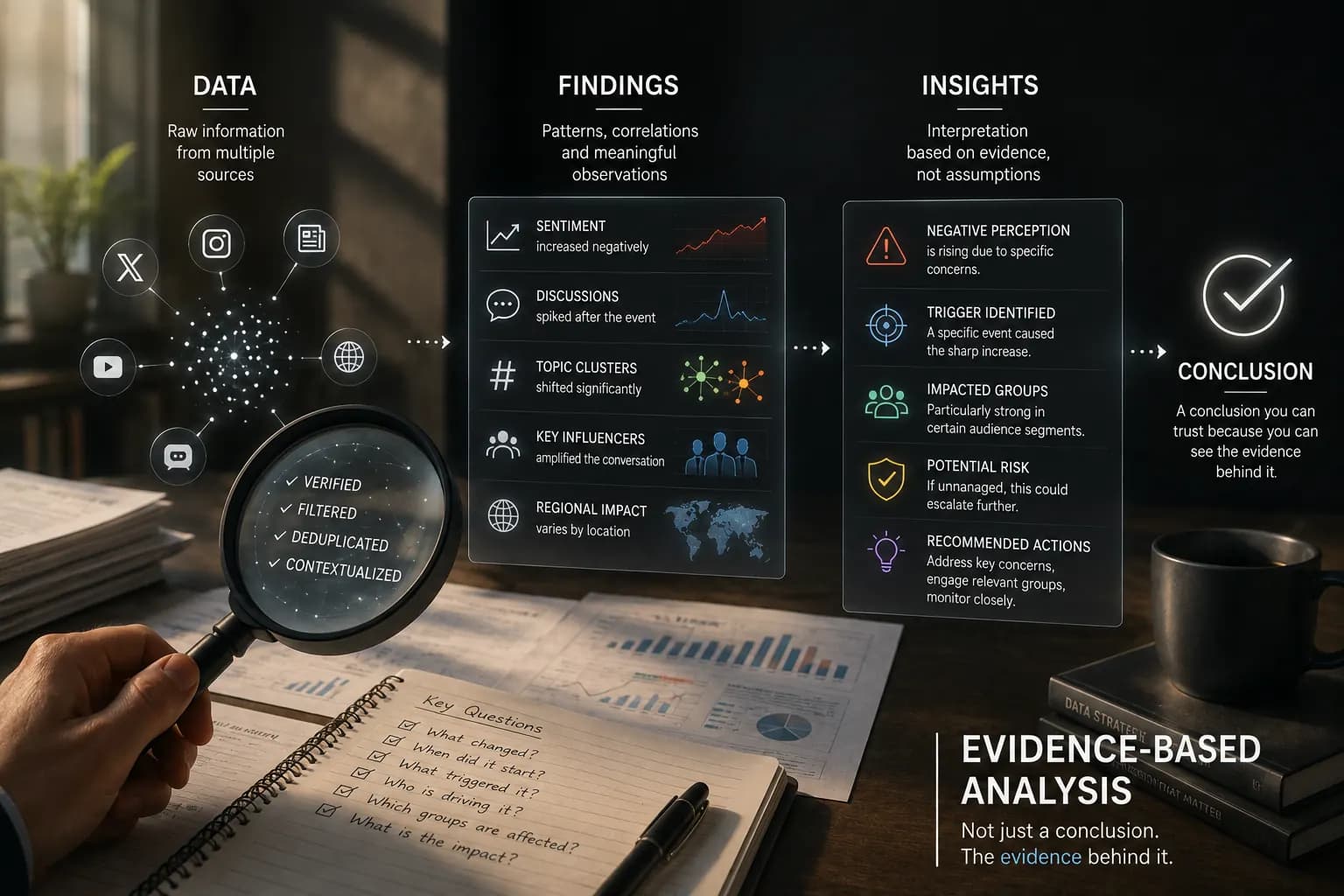
An analysis can present you with a strong conclusion.
Perception is changing.
A crisis is beginning.
This topic is resonating with the public.
A particular group is reacting.
A competitor's influence is rising.
But why should you trust these conclusions?
In analysis the real matter is not simply arriving at a conclusion. It is being able to show which data, relationships and findings that conclusion rests on.
Evidence-based analysis is an approach founded on supporting the conclusions presented with examinable data and findings, and on establishing the link between interpretation and its basis clearly.
A Conclusion Alone Is Not Evidence
Stating in a report that negative perception is rising is a conclusion.
But for a decision maker there are further questions behind it:
- Which data supports this conclusion?
- When did the change begin?
- Alongside which topics did it occur?
- Which content or events had an effect?
- In which audiences is it more pronounced?
- Does the conclusion rest on sufficient and reliable data?
Without answers to these questions, analysis can easily turn into nothing more than an opinion.
Data → Finding → Conclusion
In strong analysis it is important to keep these three stages apart.
- Data
- Constitutes the observed reality.
- Finding
- The meaningful change or relationship that emerges from examining the data.
- Conclusion
- The interpretation reached by assessing those findings together.
For example:
A rapid rise in negative conversation about a topic over three days is data.
The fact that the rise began immediately after a particular event and concentrated around a specific criticism is a finding.
Assessing that this event was an important factor in the shift of perception is the conclusion.
An evidence-based approach cares that this chain remains traceable.
Correlation Is Not the Same as Evidence
Two events happening at the same time does not necessarily mean there is a cause-and-effect relationship between them.
While a brand's perception is falling, the visibility of another event may have risen in the same period.
That these two developments occurred together matters; but on its own it does not prove that one caused the other.
In analysis, timing, context, data structure, related factors and alternative explanations should therefore be assessed together.
Can We Trust the Data Itself?
Evidence-based analysis does not only question the conclusion.
It also questions the data used as evidence.
Seeing a large volume of conversation in the digital environment does not necessarily mean a broad social movement is taking place.
Bot accounts, spam content, repeated posts, coordinated behaviour or artificial engagement can change the picture.
There are therefore two separate questions:
What does the data say?
How well does this data represent reality?
Trusting the first without asking the second is risky.
Analysis Must Be Verifiable
Telling a decision maker only “the system says so” is not enough.
Especially where political, institutional or strategic decisions are at stake, it must be possible to understand why a conclusion emerged.
- What change was observed?
- Which findings support it?
- Which factors affect the outcome?
- How reliable is the data?
- Is another explanation possible?
These questions make analysis not only more thorough, but more open to scrutiny and more trustworthy.
In the Age of AI, Evidence Matters Even More
Artificial intelligence systems can process large amounts of data quickly and produce complex conclusions.
But a conclusion being produced quickly does not automatically make it correct.
In the analysis systems of the future, therefore, it is not only the question “What conclusion did it reach?” that matters, but
On what evidence did it reach that conclusion?
This question is becoming steadily more important.
Because strong analysis does not offer the decision maker merely an answer.
It also shows why that answer can be trusted.
Do not believe a conclusion. See its evidence.