What Is Data Intelligence? Turning Data into Knowledge and Knowledge into Decisions
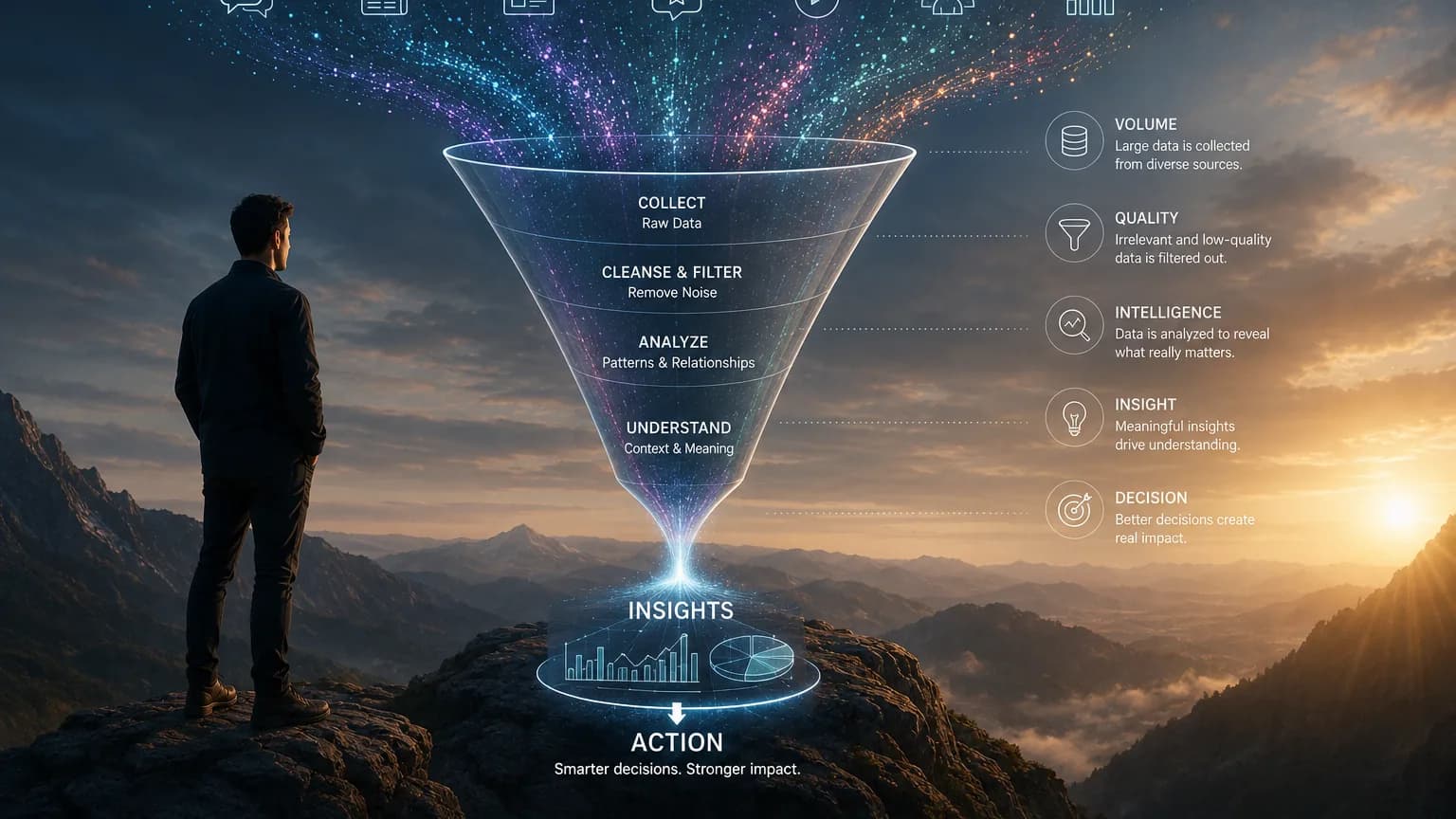
The amount of data produced in the world grows every day.
Social media conversations, news, user comments, digital behaviour, interactions, research, market data and countless other sources continuously generate new data.
But the basic problem for organisations is no longer reaching data; it is being able to understand what which data means.
Data intelligence refers to data from different sources being interpreted, connected and turned into knowledge usable in decision-making, rather than merely collected and reported.
In short, the point is not to see more data:
It is to understand what the data is telling you.
Data and Knowledge Are Not the Same Thing
That a brand was mentioned 50,000 times today is data.
That this figure is 40% higher than last week is another piece of data.
That much of the conversation is concentrated around a particular topic is a finding.
Once we see that this change began after a specific event, that it is stronger in certain audiences and that it affects brand perception, we begin to speak not merely of numbers but of a meaningful picture.
This is exactly where the value of data intelligence appears.
Data → Context → Relationship → Insight → Decision
What Do Different Data Sources Say Together?
Real-world events do not occur within a single data source.
A topic may begin on social media, move to news sites, grow in user comments and be discussed in entirely different ways across platforms.
The picture seen from a single source may therefore represent only part of the bigger picture.
The data intelligence approach makes it possible to assess different data points together.
Because sometimes the most important knowledge lies not within a single data point, but in the relationship between different ones.
What Is the Difference Between Data Analytics and Data Intelligence?
The two concepts are closely related but do not mean the same thing.
- Data analytics
- Focuses on examining data to uncover patterns, changes and findings.
- Data intelligence
- Aims to assess those analytical outputs within a wider context and turn them into a structure the decision maker can understand and use.
So while analysis asks:
What do we see in the data?
data intelligence adds to that:
What does this mean, and why does it matter to us?
That is the question it adds.
More Data Is Not Always Better
Having millions of data points can look impressive.
But if the data consists of repeated content, spam sources, bot accounts, irrelevant results or unreliable signals, volume alone provides no advantage.
In data intelligence, therefore, it is not only the quantity of data that matters, but its quality, its context, its reliability and its relationship with other data.
Even an advanced analysis built on incorrect data can reach a wrong conclusion.
Which Questions Does Data Intelligence Answer?
The value of data intelligence is not measured by how many different metrics sit on a dashboard.
Its value lies in being able to draw answers to important questions out of complex data.
- What is changing?
- Why is it changing?
- What is triggering the change?
- Who is influencing it?
- Which topics are rising?
- Which risks are forming?
- Which opportunities are emerging?
- What should we watch from here on?
Only when data begins to answer these questions does it produce real value for decision-making.
How Is AI Changing Data Intelligence?
Artificial intelligence makes it possible to process very large and complex datasets and to assess the relationships within them far more quickly.
But not every interpretation an AI produces is automatically correct.
In a modern data intelligence approach, therefore, context, data reliability, verifiability and evidence matter as much as speed.
The value of tomorrow's analytical systems will come not from processing more data, but from making sense of the right data in the right context.
The Value of Data Appears the Moment It Changes a Decision
What organisations need is not hundreds of new charts or thousands of new metrics.
What they really need is to see, among millions of data points:
- Which one matters?
- Why does it matter?
- What is changing?
- And what should we do about it?
It is being able to see the answers to these questions.
Data is what you have. Data intelligence is what you understand from it.