How Is a Political Figure's Perception Measured? How a Leader Is Seen by Society
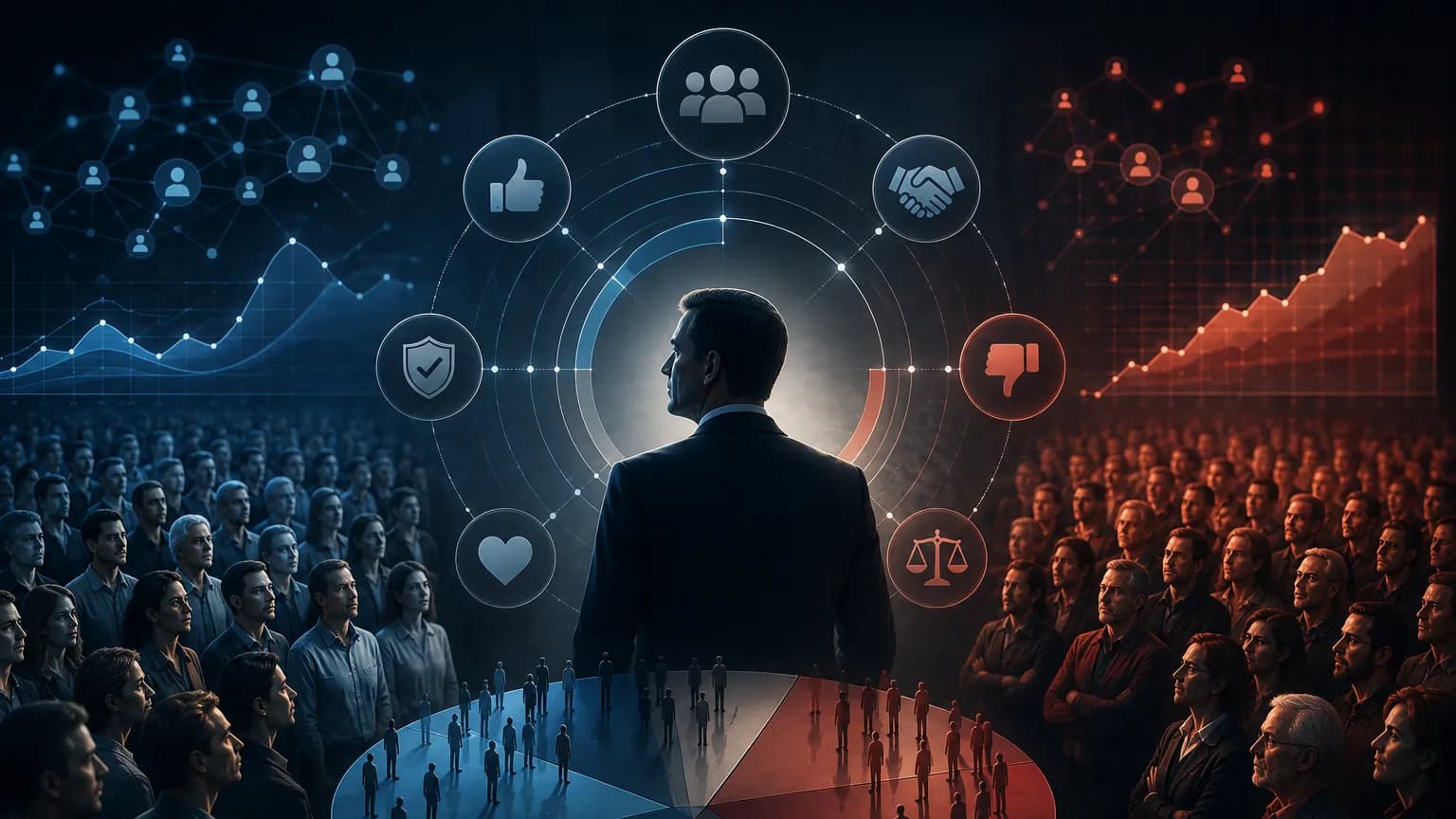
That a political figure is talked about a great deal does not show that they hold a strong perception.
High visibility may not mean support. Nor does an abundance of favourable conversation on its own explain why people support that person.
Because political perception is not merely favourable, unfavourable or neutral.
People can judge a political figure as strong yet distant, successful yet not trustworthy, sincere yet ineffective, decisive yet uncompromising, all at once.
The real question for analysing a political figure is therefore not this:
Do people like this person?
It should be this:
What kind of person are they in people's minds?
Perception Is More Than Sentiment
Sentiment analysis is an important starting point.
But knowing that a person is spoken of favourably does not explain which traits that favourable perception rests on.
A political figure may be seen as trustworthy, strong, sincere, decisive, successful, one of the people, innovative, experienced or approachable.
In the same way, unfavourable perception can form around different character traits.
What matters here is not only which traits stand out, but how those traits change over time.
Is the Person People See the Same as the One They Want to See?
One of the most important dimensions of political perception is expectation.
Society may expect stronger leadership, more empathy, an economic solution, trust, change or stability from a leader.
But if the current perception does not meet those expectations, a perception-expectation gap emerges.
A figure may be associated with strong leadership, for instance, while society's core expectation in that period has shifted towards “a leader who listens and understands”.
In that case, a strong perception may not be enough on its own.
Because in politics what matters is not only how you are seen, but what people want to see from you.
Supporters, Opponents and the Undecided See the Same Person Differently
A political figure does not have a single perception.
Supporters may judge them as decisive while opponents read the very same behaviour as authoritarian.
Undecided voters may focus on an entirely different trait.
General averages can therefore conceal important divergences.
The real question is this:
Who interprets which trait, and how?
Once this distinction is visible, not only the figure's general image but the perception map formed across different audiences can be understood.
Can One Event Change a Leader's Perception?
Yes.
A speech, the handling of a crisis, an economic development, a debate, a political decision or a social event can change the traits people associate with a political figure.
Here, seeing that the change happened is not enough on its own.
- When did it begin?
- Which event did it change with?
- Which trait was affected?
- In which audiences was it stronger?
- Is the change temporary or lasting?
This allows political perception to be treated as a structure moving over time rather than a static snapshot.
Is What the Media Sees the Same as What Citizens See?
Not always.
A political figure may be framed with certain traits in the media while entirely different traits stand out in citizens' conversations.
The organisation's observations on the ground can produce a third picture.
This divergence matters especially.
Because the gap between media perception, citizen perception and organisational perception helps show whether the picture seen inside a political figure's own circle matches their standing in society.
Perception Changes When Compared with Rivals
Political perception is not assessed through one person alone.
One figure may be perceived as strong on “the economy” while another stands out on “trust”.
One may resonate more strongly with young voters while another gains an advantage in a different social group.
Analysing a political figure should therefore look at the second question alongside the first:
How is this person perceived?
On which traits do they differ from the other figures?
Because in politics perception is also a comparative position.
The Difference Between Visibility and Reputation
A political figure can sit at the centre of the agenda and still be weakening on core character perceptions.
The reverse is possible too.
A less visible figure can build a steadily stronger position on particular traits.
Drawing conclusions about political power from mentions, reach or media visibility alone can therefore be misleading.
Visibility shows you who is being talked about.
Perception analysis tries to understand what is forming about that person.
The Real Question of Political Perception
Analysing a political figure should aim at more than producing a single score at the end.
A decision-maker should be able to see:
- How do people define me?
- What do they expect from me?
- Which of my traits are strengthening or weakening?
- Why do my supporters support me?
- Why do my opponents criticise me?
- What determines the perception of the undecided?
- On which traits do rivals differ from me?
- And how does this picture change over time?
Because one of the greatest fallacies in political communication is assuming that how you describe yourself and how people see you are the same thing.
A political image is not the person you want to present. It is the person formed in people's minds.