What Is Social Media Monitoring? The Difference Between Tracking and Understanding
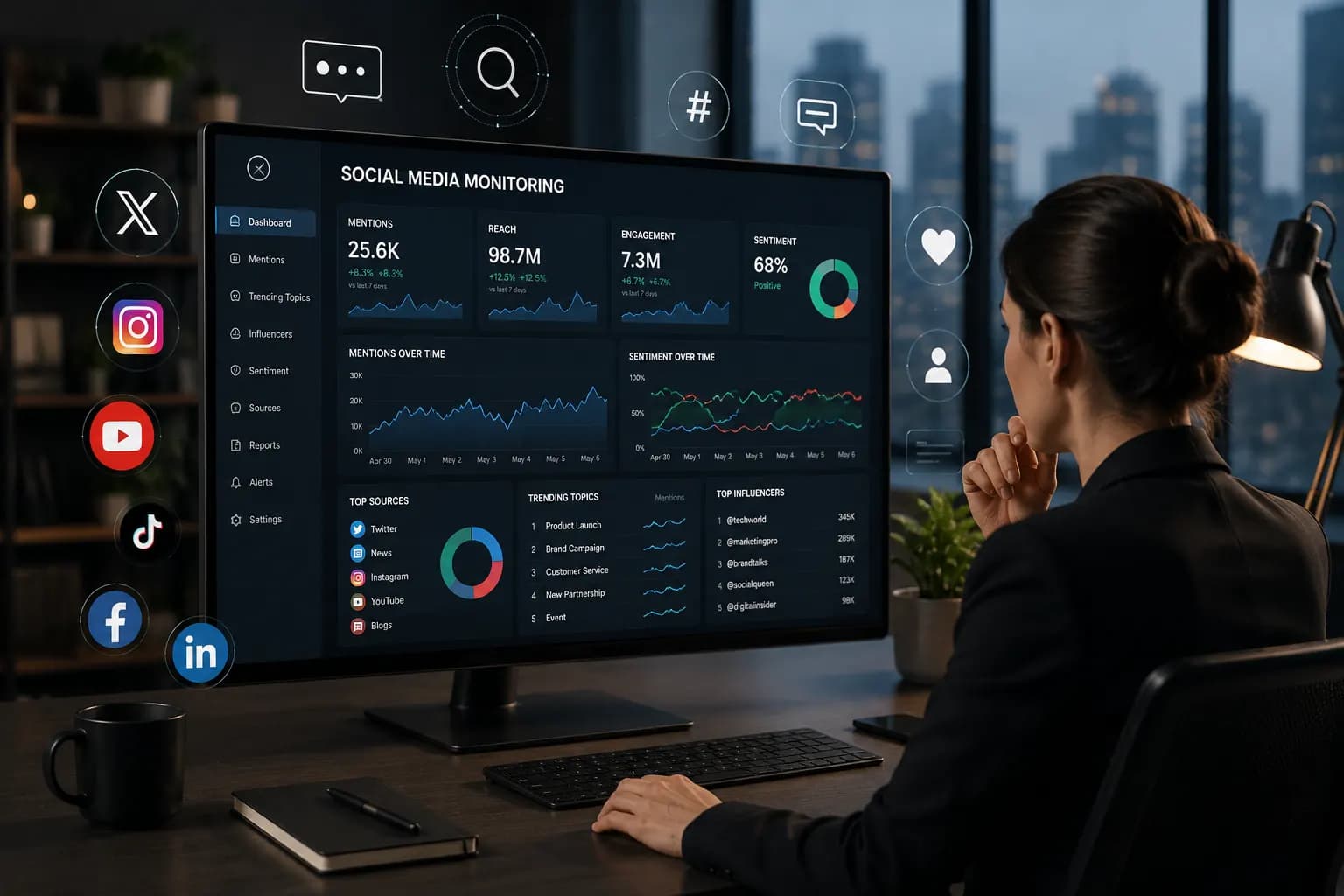
How many posts were made about a brand today? Where was a person mentioned? Which news stories were published? How often was a keyword used?
These questions matter for tracking the digital world.
But tracking something is not the same as understanding it.
Social media monitoring is the systematic tracking of posts and interactions about specific brands, people, organisations, products, topics or keywords across social platforms.
Its basic purpose is to make visible what is being said in the digital world, and when.
What Does Social Media Monitoring Track?
Monitoring systems can watch different data depending on the need.
Brand and product names, names of people or organisations, keywords, hashtags, user comments, posts, mentions, interactions and conversations forming around particular topics can all be among them.
This allows organisations to follow, in a more orderly way, the movements forming in the digital environment about themselves or the subjects they care about.
But at this point an important distinction appears.
Collecting data is the beginning of analysis, not its conclusion.
What Is the Difference Between Monitoring and Social Media Analysis?
Monitoring mostly answers these questions:
- Who spoke?
- Where was it discussed?
- What was said?
- How much was it discussed?
- When was it discussed?
Analysis then adds new questions on top of these:
- Why is it being discussed?
- Why is perception changing?
- Which topic is triggering the change?
- Who is influencing the movement?
- What emotions and intentions lie behind the conversations?
- Could this movement be a risk, an opportunity or the signal of a larger change?
This is where the fundamental difference appears.
- Monitoring
- Captures the data.
- Analysis
- Reveals what the data says.
More Data Does Not Mean More Insight
Collecting thousands of mentions or tracking millions of posts can technically produce a large volume of data.
But within that data there may be spam content, repeated posts, bot accounts, irrelevant results or artificial engagement.
What matters is therefore not only how much data was collected, but how meaningful and reliable the analysed data is.
Otherwise more data can produce more noise rather than more accurate conclusions.
Why Does Monitoring Still Matter?
Because you first have to be able to see what you are going to analyse.
Monitoring is an important first layer that captures developments forming in the digital world, from brand tracking to crisis signals, from competitor moves to shifts in the agenda.
In today's data landscape, however, the real value begins after that point.
Filtering, verifying, connecting and interpreting the collected data through different analytical layers turns simple tracking into a structure that supports decision-making.
Social Media Monitoring vs. Social Listening
Social media monitoring is often mentioned together with social listening. Monitoring captures mentions and alerts you when something happens. Social listening analyzes the same data to explain what the conversation means and why it is changing. Monitoring is the layer that listening is built on.
What Should You Monitor? A Checklist
- Brand, product and service names, including common misspellings and abbreviations.
- Executives and spokespeople.
- Campaign names, slogans and hashtags.
- Competitors and their main products.
- Sector topics and regulations that affect you.
- Customer service terms such as delivery, refund, outage and support.
- Risk words for your sector, such as recall, data breach or safety.
How to Set Up Social Media Monitoring in 6 Steps
- 1. Define the goal
- Decide whether monitoring is mainly for responding to customers, protecting reputation, following campaigns or catching crises early. The goal decides everything else.
- 2. List the terms
- Use the checklist above, and add exclusions for unrelated meanings of the same words so the results stay relevant.
- 3. Choose the sources
- Cover the platforms your audience uses, including comments and replies, and add news sites, forums and complaint sites where detailed opinions appear.
- 4. Set alerts
- Alert on unusual change, not only on fixed numbers: a sharp rise in negative posts, a new topic spreading or a high-reach account mentioning you.
- 5. Assign owners
- Decide who reads alerts, who responds and who escalates. An alert nobody owns is the same as no alert.
- 6. Review and refine
- Check the results weekly, remove noise, add new product and campaign names and adjust alerts that fire too often or too late.
Which Metrics Should You Track?
- Mentions and reach
- How often you are mentioned and how far those posts travel.
- Sentiment and tone
- Whether mentions are positive, negative or neutral, read in context so that irony is not counted as praise.
- Share of voice
- Your share of the conversation compared with competitors.
- Top topics
- What the mentions are about, and which topics are growing.
- Unusual spikes
- Sudden changes in volume or tone that break the usual pattern.
- Response time
- For your own channels, how quickly questions and complaints get an answer.
When Should an Alert Fire?
- Negative posts rise well above their usual level within a few hours.
- A new topic appears and starts spreading across platforms.
- A journalist or a high-reach account posts about you.
- Risk words appear next to your brand name.
- A post about you is being shared much faster than usual.
Frequently Asked Questions
- What is the difference between social media monitoring and social listening?
- Monitoring captures mentions and alerts you to them. Social listening analyzes that data to explain what the conversation means and why it is changing.
- Is social media monitoring legal?
- Tracking publicly accessible posts is a common practice, but it should respect platform terms and data protection laws, and avoid collecting personal data that is not needed.
- Do I need a tool for social media monitoring?
- For a handful of terms, manual searches can work. Once you track several names, platforms and languages, or need alerts, a tool saves time and misses less.
- How often should I check social media monitoring results?
- Alerts should be watched in real time. Overall trends are best reviewed weekly, so that one busy day does not distort the picture.
Tracking Is the Beginning
You can track millions of conversations in the digital world.
But for a decision maker the real question is not how many posts there are.
It is knowing why those conversations happened and what they mean.
Monitoring shows you what happened. Analysis tells you why it matters.