What Is Crisis Analysis? How a Crisis Begins, Grows and Fades
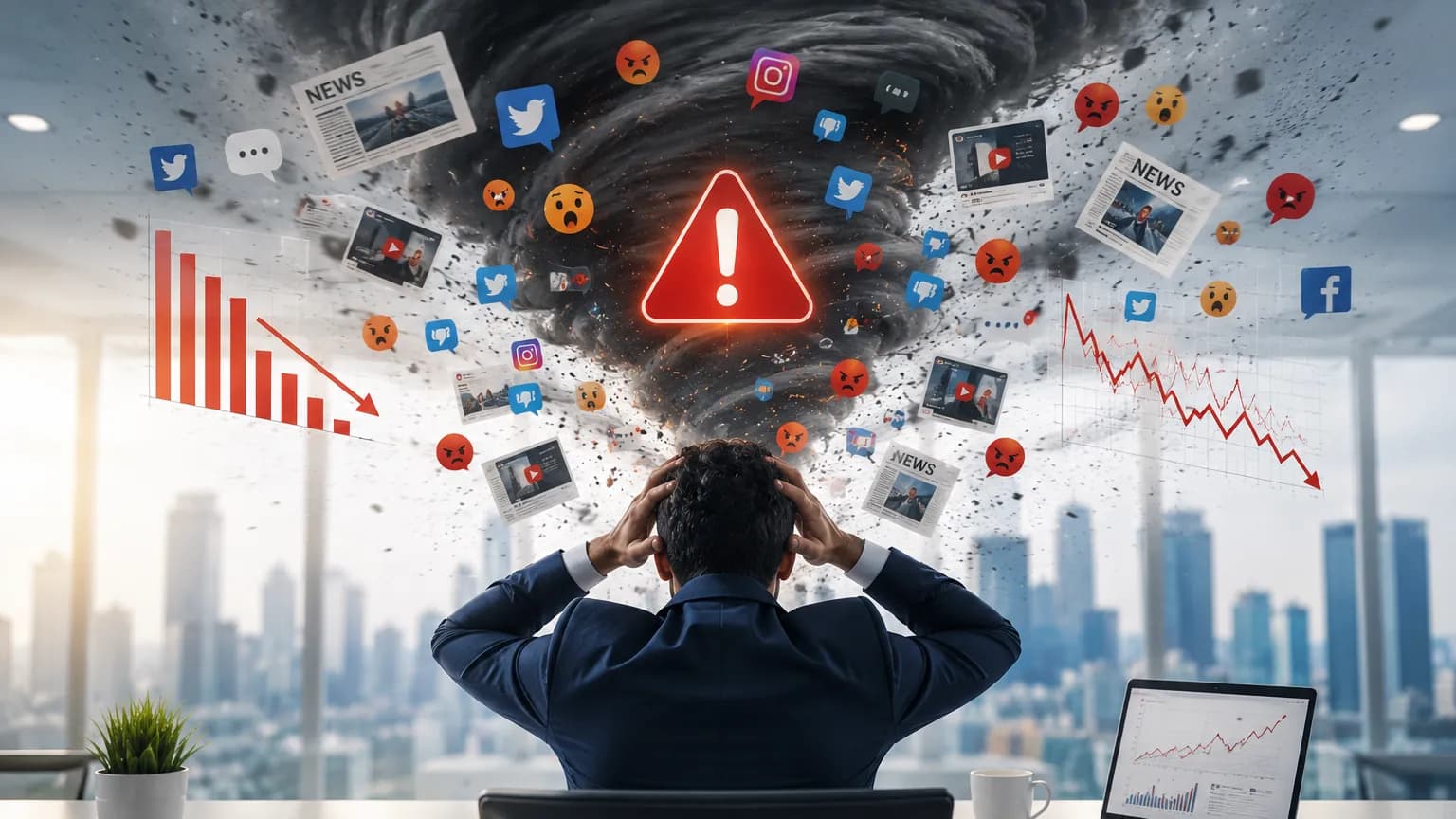
A crisis is usually noticed once everyone is already talking about it.
Yet the crisis may not have begun at that moment.
Recurring small complaints, language that starts shifting around a particular topic, an unusual spike in conversation, a post from an influential account, or previously unrelated reactions suddenly converging on the same subject…
Major crises are sometimes preceded by small signals.
Crisis analysis is the process of understanding a risk's full arc, from emergence through spread to fading impact, together with its source, the actors involved, how it spreads, and its effect on perception over time.
Because seeing the crisis is not the only thing that matters.
What matters is understanding where it started, why it grew, and where it is heading.
Not Every Negative Conversation Is a Crisis
A brand can attract hundreds of negative comments and still lose momentum within a few hours.
Conversely, a topic that only a handful of people are discussing at first can spread to different communities over time and turn into a full-blown crisis.
This is why a crisis cannot be measured by negative mention count alone.
The speed at which the conversation grows, who is spreading it, which audiences it reaches, how long it lasts, and what other topics it merges with all need to be assessed as well.
Where Did the Crisis Start?
Once a crisis grows large, its source can become invisible.
Amid thousands of posts, news articles, and comments, it becomes difficult to trace where the first movement came from.
Yet knowing the source matters for understanding the crisis's true nature.
- Was it a customer complaint?
- A news story?
- A video?
- An employee statement?
- A political development?
- Or an old, pre-existing problem resurfacing?
The crisis may not have started where it appears to have.
This is why tracing the timeline backward can help uncover the crisis's earliest signals and the developments that triggered it.
Why Does a Topic Grow?
Not every criticism spreads.
Some topics disappear after a handful of posts, while others reach broad audiences within hours.
The reason isn't always the content itself.
The involvement of influential accounts, coverage by news media, the participation of different communities, the emergence of strong emotions, or the topic merging with a larger social sensitivity can all accelerate its spread.
This is why crisis analysis needs to look not only at how much something has grown, but at what grew it.
Who Is Carrying the Crisis?
A crisis may appear to be discussed by thousands of people.
But a significant share of that activity may actually be generated by a limited number of accounts.
- Some users may start the conversation.
- Some may carry it into different communities.
- Some may amplify its media visibility.
- And some may simply be repeating the existing conversation.
Bots, spam, or coordinated activity can also make the visible volume appear larger than it really is.
So alongside the first question, a second one matters just as much:
How many people are talking?
Who is talking, and who is amplifying the movement?
Volume and Impact Are Not the Same Thing
Not every widely discussed crisis causes major reputational damage.
A crisis that looks smaller, on the other hand, can erode trust within a brand's most important consumer segment.
This is why evaluating a crisis requires looking beyond conversation volume, at perception, shifts in sentiment, trust, the audiences affected, and whether the topic continues to be associated with the brand.
Because the real risk sometimes lies not in the size of the conversation, but in the shift in perception it leaves behind.
Did the Response Reduce the Crisis or Amplify It?
A statement was issued.
An apology was published.
Content was taken down.
A new decision was announced.
So what happened next?
In crisis management, taking action is not enough; measuring the impact of that action matters just as much.
- Did the conversation volume drop?
- Did negative sentiment ease?
- Did new criticisms emerge?
- Did the subject of the debate shift?
- Did the statement gain support, or did it trigger a fresh backlash?
This assessment reveals whether the response actually worked.
When Does a Crisis End?
A drop in conversation volume doesn't necessarily mean the crisis is fully over.
Even after the news cycle has calmed down, a certain negative perception may persist.
Months later, another incident can bring the old crisis back into memory.
This is why the end of a crisis should not be judged solely by mention counts returning to normal.
The real question is this:
Has the news cycle ended, or has its impact ended too?
The Real Value of Crisis Analysis Starts Before the Crisis
Crisis analysis is not just a report prepared after the fact.
One of its more valuable uses is catching unusual activity while it is still small.
- A recurring complaint…
- An unexpected shift in sentiment…
- A conversation growing faster than usual…
- A new community joining the topic…
None of these may be a crisis on its own.
But when different signals start pointing to the same thing, a risk worth examining more closely may be emerging.
A crisis is visible once everyone can see it. The real advantage is spotting the shift before it becomes one.